

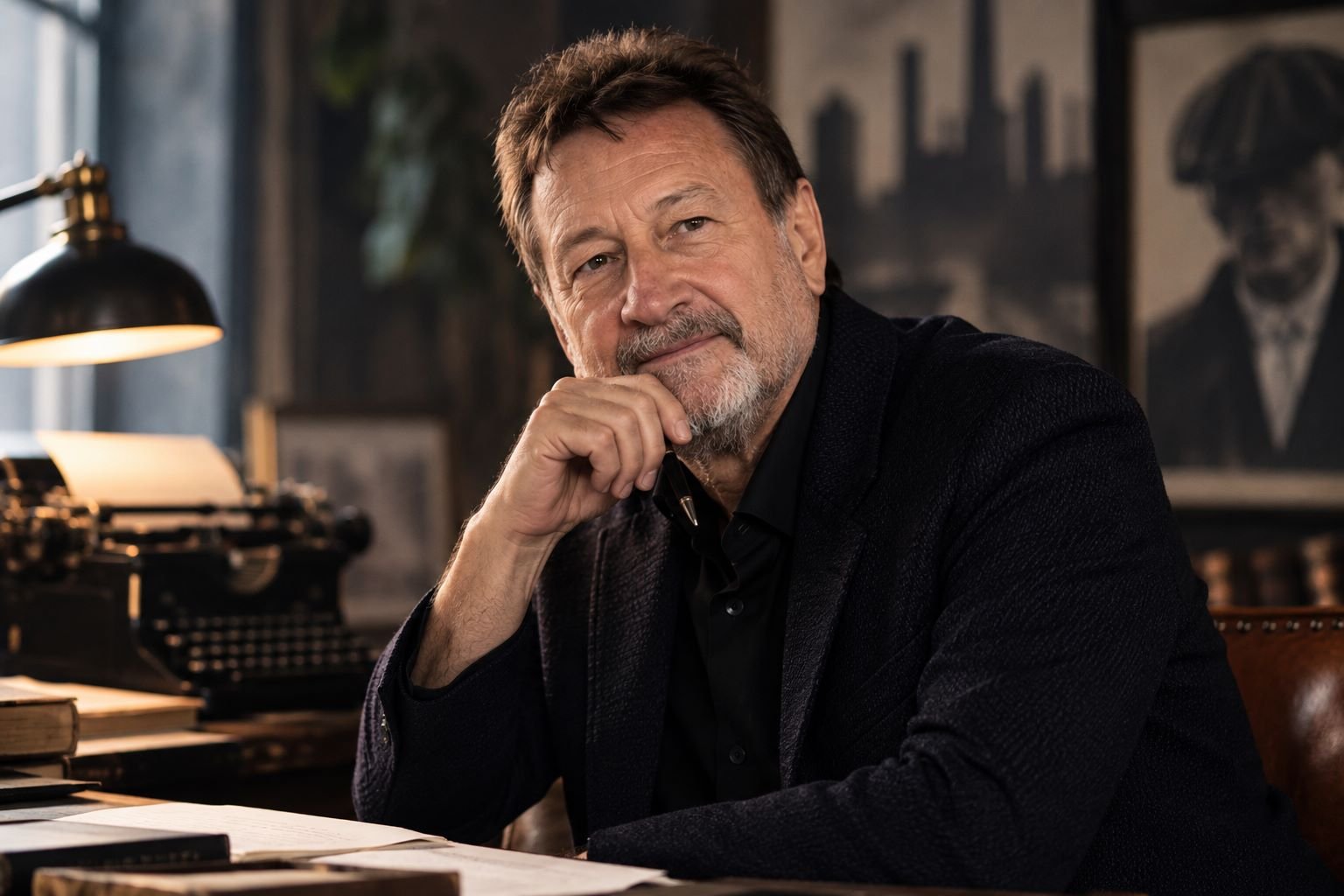
Steven Knight is the BAFTA-winning British screenwriter, director, and producer behind Peaky Blinders, Dirty Pretty Things, and Eastern Promises. In 2026, he is writing Bond 26 for Amazon MGM Studios, celebrating Netflix’s House of Guinness season 2 renewal, and releasing the Oasis documentary Don’t Look Back in Anger after its Venice Film Festival premiere.
Knight has built a career on crime, history, family loyalty, class, and survival. His work turns Birmingham roots, working-class memory, and British-Irish history into stories with global reach, from the Shelby family saga to Victorian boxing in A Thousand Blows and the Guinness brewing dynasty in 19th-century Dublin.
Table of Contents
Who Steven Knight Is
Knight is a British writer and filmmaker from Birmingham, widely recognized for joining historical settings to fictional characters and modern social pressure. Before prestige television, he co-created the global game show format Who Wants to Be a Millionaire?, which aired in around 160 countries and territories and gave him an early industry profile.
His film breakthrough came with Dirty Pretty Things in 2002, a drama about undocumented immigrants in London that earned an Academy Award nomination for Best Original Screenplay. He followed it with Eastern Promises in 2007, David Cronenberg’s crime thriller about the Russian mafia in London. Those films established a signature interest in underworld networks, migration, secrecy, and people pushed to the edge.
Knight also proved himself as a director with Locke in 2013. The film stars Tom Hardy as a construction manager managing personal and professional collapse during a real-time highway drive, told through phone calls inside a moving car. The setup showed his belief that sharp character writing can hold tension without conventional action scenes.
The Peaky Blinders Effect
Knight’s defining television work is Peaky Blinders, the BBC crime drama starring Cillian Murphy as Thomas Shelby. The series ran for six seasons from 2013 to 2022 and became one of the most internationally recognized British dramas of its period.
The show was inspired partly by family stories from Birmingham’s criminal underworld, but it is not a direct retelling of the real Peaky Blinders. The historical gang was a Birmingham street group active mainly in the late 19th century, not the powerful criminal empire shown on screen. Knight used the name, local folklore, and post-World War I upheaval as the foundation for a broader fictional story about trauma, loyalty, power, ambition, and the cost of survival.
The result was a global phenomenon credited with boosting tourism and cultural interest in the West Midlands, often called the “Peaky effect.” Its appeal rests on family conflict, political tension, stylized visuals, modern music, and an emotional focus that treats working-class characters as ambitious and resourceful rather than only as victims.
Major Projects Across Film and Television
Table
| Project | Knight’s role | Why it matters |
|---|---|---|
| Dirty Pretty Things | Co-writer | Established his film reputation and brought an Oscar nomination |
| Eastern Promises | Writer | Expanded his crime-drama range with Cronenberg |
| Locke | Writer and director | A contained Tom Hardy thriller built on dialogue and pressure |
| Peaky Blinders | Creator and writer | His signature series and a global franchise |
| Taboo | Co-creator and writer | Colonial-era London, revenge, and power |
| SAS: Rogue Heroes | Creator and writer | Dramatizes the origins of the Special Air Service |
| A Thousand Blows | Creator and writer | Victorian boxing, class, migration, and survival |
| House of Guinness | Creator and writer | Netflix dynasty drama renewed for season 2 |
| Bond 26 | Screenwriter | The next James Bond film after No Time to Die |
He has also written bold BBC and FX revisions of A Christmas Carol and Great Expectations, replacing cozy period familiarity with psychological grit and faster contemporary pacing.
What Steven Knight Is Working on Now
Peaky Blinders: The Immortal Man
Knight wrote Peaky Blinders: The Immortal Man, the feature continuation of the Shelby story, directed by Tom Harper and starring Cillian Murphy. Released on Netflix on March 20, 2026, the film moves into the World War II era and opens by recreating the 1940 bombing of the Birmingham Small Arms factory, where Knight’s mother worked during the war. It functions as both continuation and transition for the larger Peaky universe.
Bond 26
In July 2025, Knight was announced as screenwriter for Bond 26, the 26th James Bond film, with Denis Villeneuve directing for Amazon MGM Studios. The film follows No Time to Die and is expected to introduce a new actor as 007 after Daniel Craig’s tenure. Knight has said he is developing the script with attention to Ian Fleming’s core literary tone. In September 2026, he declined to discuss casting rumors, saying he could not speak about the subject, while acknowledging that knowing who had been cast made the job a little easier. The project is expected to begin production in 2027 with a planned 2028 release.
House of Guinness Season 2
Knight’s Dublin-set period drama House of Guinness, centered on the brewing dynasty after the death of Sir Benjamin Guinness, was renewed by Netflix on August 24, 2026, nearly a year after its first season premiere. The renewal signals continued platform confidence in Knight’s historical storytelling beyond Peaky Blinders.
Oasis: Don’t Look Back in Anger
Knight is the writer behind Oasis: Don’t Look Back in Anger, a documentary about the band’s 2025 reunion and the fraught but functional relationship between Liam and Noel Gallagher. Directed by Dylan Southern and Will Lovelace, the film premiered at the Venice Film Festival in early September 2026, with Knight appearing on the red carpet alongside the Gallaghers and directors. Early IMAX screenings began September 9, 2026 in the UK and North America, followed by a wider theatrical release on September 11. International streaming is planned on Disney+, with U.S. availability through Hulu and Disney+ later in the year.
Birmingham, Digbeth, and His Creative Base
Knight’s connection to Birmingham runs deeper than subject matter. He grew up in a working-class environment there and has said it took years to believe he was as capable as other people. He did not write Peaky Blinders until his 50s, a delay that gave his later work the pressure of lived memory rather than borrowed attitude.
He is also helping turn Birmingham into a production center through the Digbeth Loc. Studios development, a complex intended to expand West Midlands capacity for major television dramas and features, including his music-focused series This Town. Knight has backed local training programs so regional crew members and technicians can find direct employment on high-budget productions. His broader contribution to British screen culture and the West Midlands was recognized with a CBE.
Why His 2026 Slate Matters
Knight’s current projects show a clear strategy. Bond 26 attaches him to one of cinema’s most valuable franchises and a director-led reboot. House of Guinness extends his method of turning family power struggles into durable historical drama. The Oasis documentary captures a live cultural moment at the exact point when reunion nostalgia becomes box office and streaming demand. The Peaky feature proves the Shelby story can move from series to film while keeping its Birmingham soul.
For audiences, the common thread is character under pressure immigrants hiding in plain sight, veterans rebuilding violent lives, boxers fighting for dignity, brewers defending a name, and a band reuniting under public scrutiny. For the industry, Knight’s slate signals confidence in writer-driven franchises that can move between intimate indie filmmaking and global blockbusters without losing a recognizable voice.
