


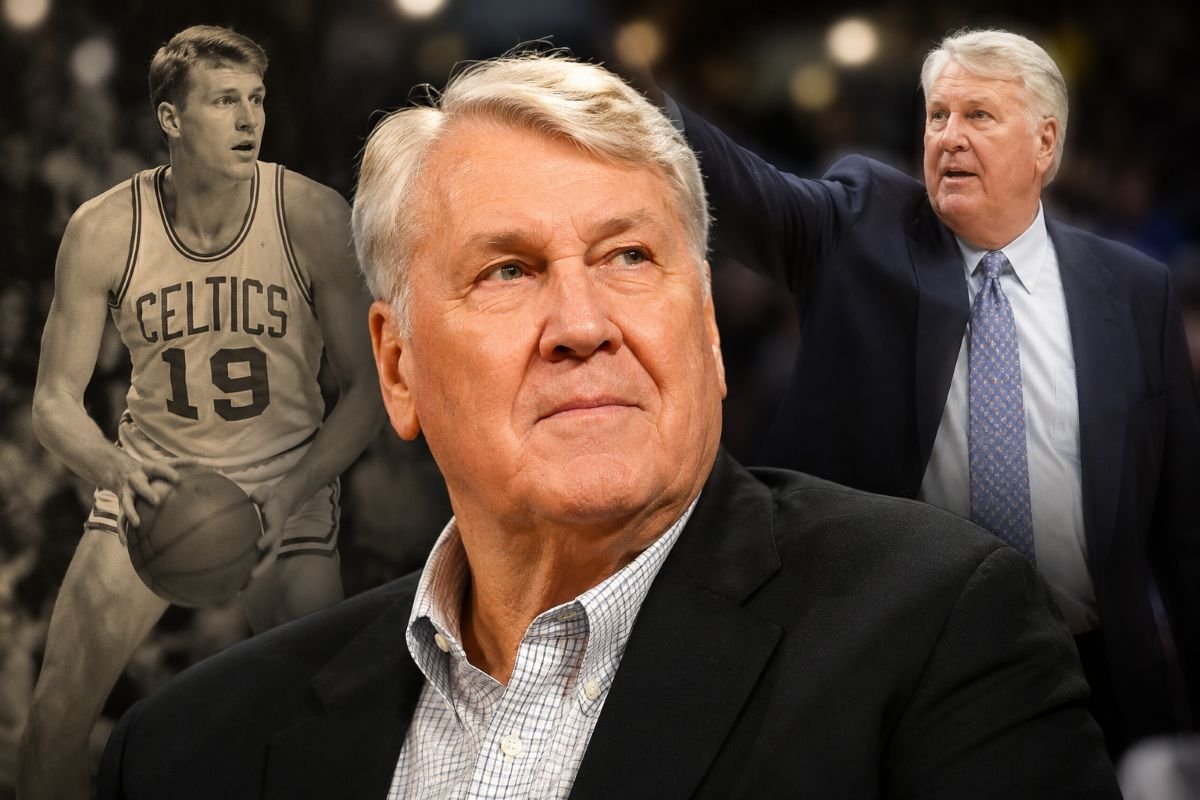
Don Nelson, the Basketball Hall of Famer who won five NBA championships as a Boston Celtics player and retired as the second-winningest head coach in league history, died on August 9, 2026, in Frisco, Texas, at age 86. His family confirmed his death in a statement, saying he passed peacefully surrounded by loved ones after suffering a stroke three weeks earlier and being placed in hospice care.
“On Sunday morning our beloved husband, dad, grandfather and great-grandfather Don Nelson peacefully went to be with the Lord, surrounded by his loving family,” the family said. “Throughout his last week, friends and family encircled him with love, sharing the blessing of his friendship and revisiting treasured memories.”
Nelson spent more than four decades in professional basketball as a player, head coach and general manager. He is best remembered for inventing “Nellie Ball,” an unconventional offensive system built on pace, floor spacing and positional flexibility that reshaped how modern NBA teams construct rosters and run their offenses.
Championship Playing Career in Boston
Born May 15, 1940, in Muskegon, Michigan, Don Nelson grew up on his grandfather’s farm near Sherrard, Illinois, before his family moved to Rock Island, Illinois. He starred at the University of Iowa, where he left as the program’s all-time leading scorer, before the Chicago Zephyrs selected him in the third round (17th overall) of the 1962 NBA draft.
After stints with the Zephyrs and the Los Angeles Lakers, Don Nelson signed with the Boston Celtics as a free agent on October 28, 1965, ahead of the 1965–66 season. Playing alongside Bill Russell and John Havlicek, he became a key reserve forward and won five NBA championships with the Celtics in 1966, 1968, 1969, 1974 and 1976.
His most famous moment came in Game 7 of the 1969 NBA Finals against the Los Angeles Lakers, when his late jumper bounced high off the back rim before dropping through to help seal the title. The Celtics retired his No. 19 jersey in 1978. Across 14 NBA seasons, Don Nelson averaged 10.3 points and 4.9 rebounds per game; in 11 seasons with Boston, he averaged 11.4 points and 5.2 rebounds.
A 31-Season Coaching Career
Nelson moved directly into coaching after retiring as a player in 1976, joining the Milwaukee Bucks as an assistant before taking over as head coach that same season. He went on to coach four franchises over 31 seasons, finishing with a regular-season record of 1,335 wins and 1,063 losses a .557 winning percentage that ranked as the NBA’s all-time record for nearly 12 years, until Gregg Popovich surpassed him in March 2022. Don Nelson made 18 playoff appearances and won eight division titles, including seven straight with Milwaukee from 1979–80 through 1985–86.
| Team | Years | Notable Detail |
|---|---|---|
| Milwaukee Bucks | 1976–1988 | Seven straight division titles; two Coach of the Year awards |
| Golden State Warriors (first stint) | 1988–1995 | Built the “Run TMC” era with Tim Hardaway, Mitch Richmond and Chris Mullin |
| New York Knicks | 1995–1996 | Introduced up-tempo concepts in a 34–25 stint |
| Dallas Mavericks | 1997–2005 | Drafted and developed Dirk Nowitzki and Steve Nash |
| Golden State Warriors (second stint) | 2006–2010 | Coached the “We Believe” upset team; drafted Stephen Curry |
Nelson won NBA Coach of the Year three times in 1983 and 1985 with Milwaukee, and in 1992 with Golden State and served as head coach of the NBA All-Star Game twice, in 1992 and 2002. On April 7, 2010, he passed Lenny Wilkens to become the NBA’s all-time winningest coach.
“Nellie Ball” and Tactical Innovation
Nelson’s coaching philosophy centered on pace, floor spacing, three-point shooting and lineups that broke from traditional position roles. In Milwaukee, he pioneered the “point forward” concept, using forward Paul Pressey to initiate offense instead of a traditional point guard, and he regularly deployed bigger players as perimeter shooters to create matchup problems. Those ideas anticipated the positionless, perimeter-driven style that later became standard across the league.
One of the defining moments of his career came during his second Golden State stint. In 2007, his eighth-seeded Warriors (42–40) upset the top-seeded, 67-win Dallas Mavericks the franchise he had previously coached in a six-game first-round series remembered as one of the biggest upsets in NBA playoff history.
Draft-Night Legacies: Nowitzki, Nash and Curry
Nelson’s influence extended well beyond his own win total through the players he identified and developed. In Dallas, working alongside his son Donnie, then the team’s assistant general manager, he engineered the June 1998 draft-night trades that brought both Dirk Nowitzki and Steve Nash to the Mavericks.
Nowitzki credited Don Nelson directly for shaping his career. Speaking in June 2026, when Nelson received the James Naismith Family Legacy Award in Dallas, Nowitzki said Nelson “jump-started” his career and gave him the confidence to play to his strengths. “His way of seeing basketball, with the whole mismatch and shooting, just played into my hands,” Nowitzki said. “Nellie was just the perfect coach for me, to start my career here.”
In his final season as an NBA coach, Nelson pushed the Golden State Warriors to draft Stephen Curry with the seventh overall pick in 2009 despite internal skepticism. Curry later said Don Nelson had an outsized impact on his career and ranked among the sport’s greatest coaching minds. Warriors coach Steve Kerr called Nelson “a true innovator” whose small-ball approach laid the groundwork for the modern NBA.
Hall of Fame Recognition and International Career
Nelson was inducted into the Naismith Memorial Basketball Hall of Fame as a coach in 2012, recognized for combining exceptional longevity with strategic innovation. His coaching résumé also included an international chapter: he led the U.S. national team, known as “Dream Team II,” to a gold medal at the 1994 FIBA World Championship in Toronto.
In June 2025, the National Basketball Coaches Association named Nelson the recipient of the Chuck Daly Lifetime Achievement Award, presented before Game 2 of that year’s NBA Finals. NBCA president Rick Carlisle praised his influence on pace, three-point shooting and inverted offenses an honor notable for coming from his fellow coaches in recognition of his broader impact on the sport.
Life After Coaching
After retiring from coaching in 2010, Don Nelson settled in Maui, Hawaii, where he ran a farm growing flowers, coffee and cannabis. Following the deadly 2023 Maui wildfires, he opened his rental properties to families who had lost their homes. In early 2026, he relocated from Maui to Frisco, Texas, where he died several months later.
Don Nelson’s death closes out a basketball career that stretched from the Celtics’ championship dynasty of the 1960s and 1970s to the pace-and-space NBA of today a style of play his coaching helped bring into being.
