


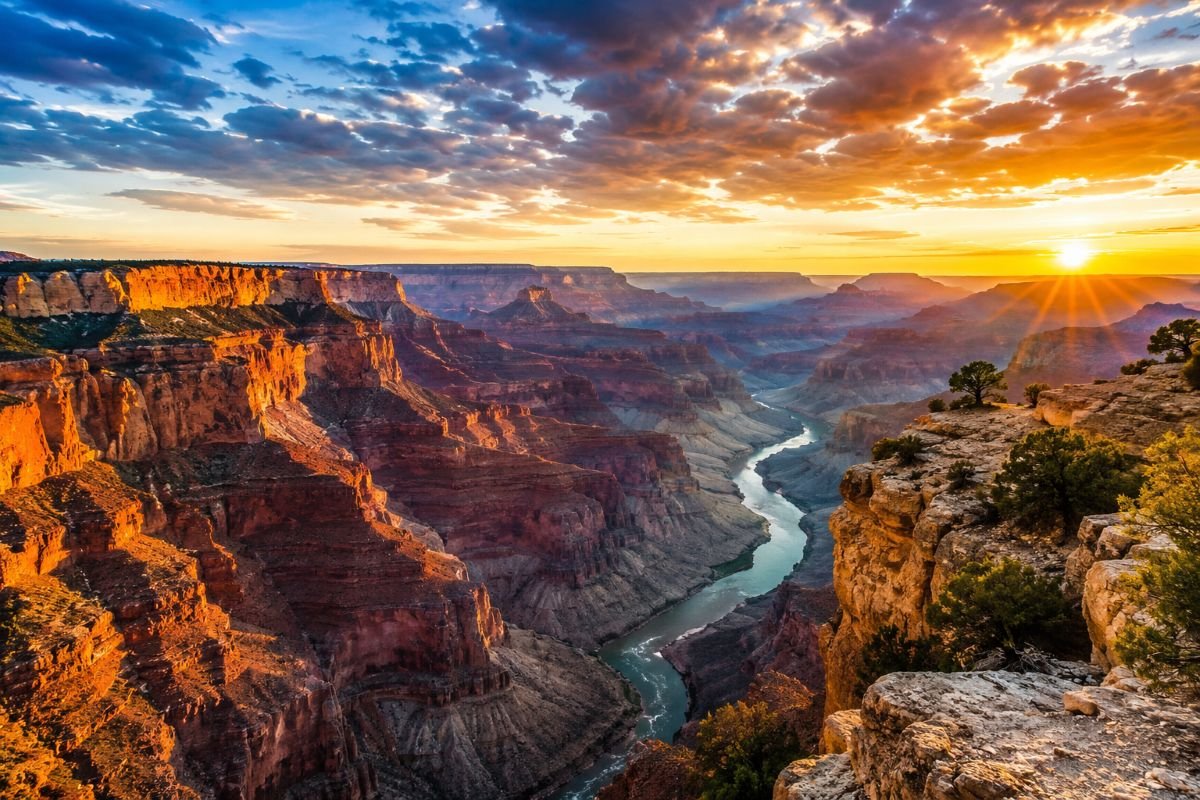
Grand Canyon National Park is open in 2026, but a failing water pipeline and an ongoing wildfire recovery mean the visitor experience is not business as usual. The South Rim runs year-round, the North Rim has reopened with major service gaps, and a hard trail closure date this fall will end traditional rim-to-rim hiking until infrastructure repairs finish. For a full breakdown of live conditions, the official NPS Key Hiking Messages page is the single most current source available.
The Grand Canyon National Park protects a gorge cut by the Colorado River across roughly 1.2 million acres in northern Arizona, running about 277 miles along the river and dropping over 6,000 feet at its deepest point. Visitation fell to about 4.4 million people in 2025, down from 4.9 million in 2024.
Why the Canyon Still Matters
Grand Canyon National Park was established on February 26, 1919, when President Woodrow Wilson signed it into law as the nation’s 17th national park. UNESCO named it a World Heritage Site in 1979 for exposing more than two billion years of geologic history.
| Fact | Detail |
|---|---|
| Established | February 26, 1919 |
| UNESCO status | World Heritage Site since 1979 |
| Size | About 1,217,262 acres |
| River length | About 277 miles along the Colorado River |
| Depth | Over 6,000 feet at the deepest point |
| Width | Up to 18 miles |
| 2025 visitation | About 4.4 million, down from 4.9 million in 2024 |
South Rim vs. North Rim at a Glance
| Feature | South Rim | North Rim |
|---|---|---|
| Elevation | About 7,000 feet | 8,000 to 8,800 feet |
| Schedule | Open 365 days a year | Seasonal, May 15 to October 15 |
| Access | Free shuttle buses, paved rim trail | Personal vehicle, remote |
| Visitor share | About 90% of traffic | About 10% of traffic |
| Lodging | Open, subject to water restrictions | No indoor lodging in 2026 |
| Water supply | Disrupted by pipeline breaks | Off at all North Rim trailhead points |
Water Status: What’s Actually On and Off Right Now
The Transcanyon Waterline is a 12.5-mile pipeline built in the 1960s that carries water from Roaring Springs on the North Rim across the canyon to the South Rim. It has broken repeatedly since 2024, and as of the most recent NPS update, the following locations along the corridor trails have no potable water because of pipeline breaks:
- North Rim (all water off; bottled water available at the General Store, 9 a.m. to 4 p.m. daily)
- North Kaibab Trailhead
- Supai Tunnel
- Manzanita Day Use Area
- Cottonwood Campground and Day Use Area
- Bright Angel Campground
- Phantom Delta Restroom
- Phantom Boat Beach
Water remains on at Phantom Ranch Canteen, Havasupai Gardens, Bright Angel Trail’s Three-Mile and Mile-and-a-Half Resthouses, Bright Angel Trailhead, and South Kaibab Trailhead. This status can change without warning if another break occurs, so hikers should treat any spigot as unreliable and check the NPS Key Hiking Messages page the same day they hike, not the week before.
Practical note: Because water status shifts location by location and can fail mid-hike, carrying a personal filtration method or treatment tablets for creek or river water is standard backcountry practice here, not an official recommendation but a widely used precaution given how often the corridor’s fixed water points have gone offline in 2025 and 2026.
Rim-to-Rim Hiking: A Hard Deadline Is Coming
A traditional rim-to-rim hike is possible right now but has a confirmed end date. Beginning October 15, 2026, at 11:59 p.m., the North Kaibab Trail will close between Redwall Bridge, about 2.5 miles north of Manzanita Rest Area, and the northern end of Cottonwood Campground, for Transcanyon Waterline repair work. NPS states directly that a traditional rim-to-rim hike, in either direction, will not be possible starting October 16, 2026. The Grand Canyon National Park has not published a confirmed reopening date for this section, so travelers should not assume a specific return date and should recheck official channels before planning any 2027 attempt.
Currently open corridor trails include the South Kaibab Trail to Phantom Ranch, the Black Bridge crossing, the Tonto Trail between Tipoff and Havasupai Gardens, Plateau Point Trail from the Tonto Trail junction, Bright Angel Trail to River Resthouse, the River Trail east to the South Kaibab junction, the Silver Bridge, and the entire North Kaibab Trail up to its future closure point.
North Rim Recovery After the Dragon Bravo Fire
The North Rim’s limited 2026 season follows the Dragon Bravo Fire, ignited by lightning on July 4, 2025. The fire burned 145,504 acres and destroyed roughly 70 structures, including the historic 1930s Grand Canyon Lodge, before reaching full containment on September 29, 2025. Suppression costs topped $135 million.
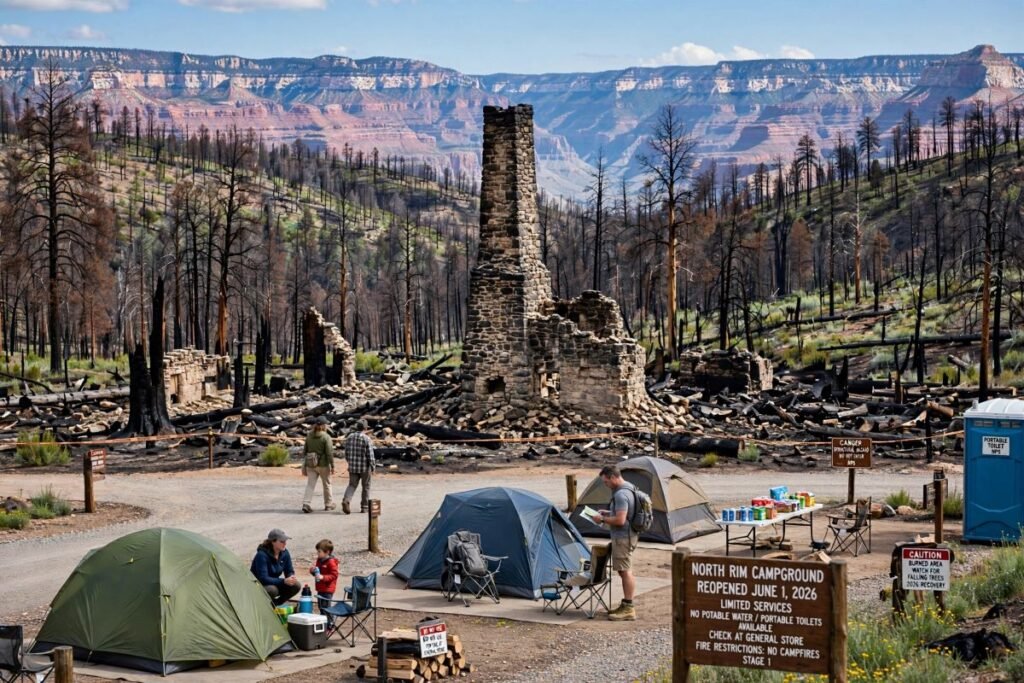
The North Rim reopened for day use on May 15, 2026, and the campground opened June 1, 2026, booked through Recreation.gov. The campground, run by a concessioner for the 2026 season, has no water hookups or RV service; campers must bring potable water or buy it at the adjacent General Store. Stage 2 fire restrictions remain in effect for the full season, banning wood and charcoal fires and outdoor smoking outside enclosed vehicles.
Trails currently closed due to fire damage include Bright Angel Point Trail, Widforss Trail, Transept Trail, Uncle Jim Trail, the western section of Ken Patrick Trail, and part of the Arizona Trail near the former lodge site. Point Imperial, the Grand Canyon National Park highest overlook at 8,803 feet, and Cape Royal Road remain accessible.
NPS has stated it is taking a phased approach to North Rim recovery, with additional services expected to return gradually in the 2027 and 2028 seasons as infrastructure repairs continue. No specific date for restored lodging has been announced.
Heat Risk in the Inner Canyon
Temperatures inside the canyon rise roughly 5.5 degrees Fahrenheit for every 1,000 feet of elevation lost. Phantom Ranch regularly runs about 30 degrees warmer than the rims in summer, and the Grand Canyon National Park most recent heat advisory rated the risk at Phantom Ranch as extreme, meaning conditions are dangerous for anyone without proper hydration or cooling.
NPS guidance for hikers below the rim includes avoiding hiking between 10 a.m. and 4 p.m., drinking water when thirsty rather than forcing fluids to avoid a salt-balance disorder called hyponatremia, and eating extra carbohydrates and salty food since hiking suppresses appetite while increasing caloric need. Burned sections of the upper North Kaibab Trail, between Supai Tunnel and the North Kaibab Trailhead, carry added risk from falling rock and debris flows, especially during or after rain.
Fees and International Surcharges
A standard vehicle permit costs $35 and covers seven days at all entrances. Individual and bicycle permits cost $20. Grand Canyon National Park-specific annual pass runs $70, and the America the Beautiful interagency pass covering all national parks costs $80. No entry reservation is required.
Since January 1, 2026, the Department of the Interior has charged a $100 per-person surcharge for non-U.S. residents aged 16 and older at 11 major parks, including Grand Canyon National Park, on top of the standard entrance fee. A non-resident annual pass costs $250, compared with $80 for U.S. residents. This surcharge applies even on the Grand Canyon National Park free entrance days.
Before You Go: A Verification Checklist
- Confirm South Rim lodging status directly with your concessioner within 24 hours of arrival, since pipeline breaks have triggered sudden Stage 4 restrictions with little notice.
- Check the NPS Key Hiking Messages page the same day you hike for current water status at every trailhead you plan to pass.
- If attempting rim-to-rim, complete the crossing before October 15, 2026, or plan around the closure with no assumed reopening date.
- Treat any water source as unreliable and carry backup filtration or treatment if hiking below the rim.
- Review current fire restrictions and burn-scar hazard warnings before hiking the upper North Kaibab Trail.
Read More Travel and lifestyle Article please visit trulyblaze lifestyle.
